
The Main Paths to Entrepreneurship Through Acquisition
Entrepreneurship through acquisition (ETA) starts with an existing business. Entrepreneurs who buy a company to run it themselves take ownership of a business with customers, a team and cash flow, then build its value through long-term operation. Search funds are one established path.
ETA can begin with finding and taking over one company. It can also involve multiple acquisitions backed by long-term capital and a holding company, or the integration of existing businesses to create a new business. A special purpose acquisition company (SPAC) raises capital in the public markets to pursue an acquisition; the target’s management team usually continues to run the business.
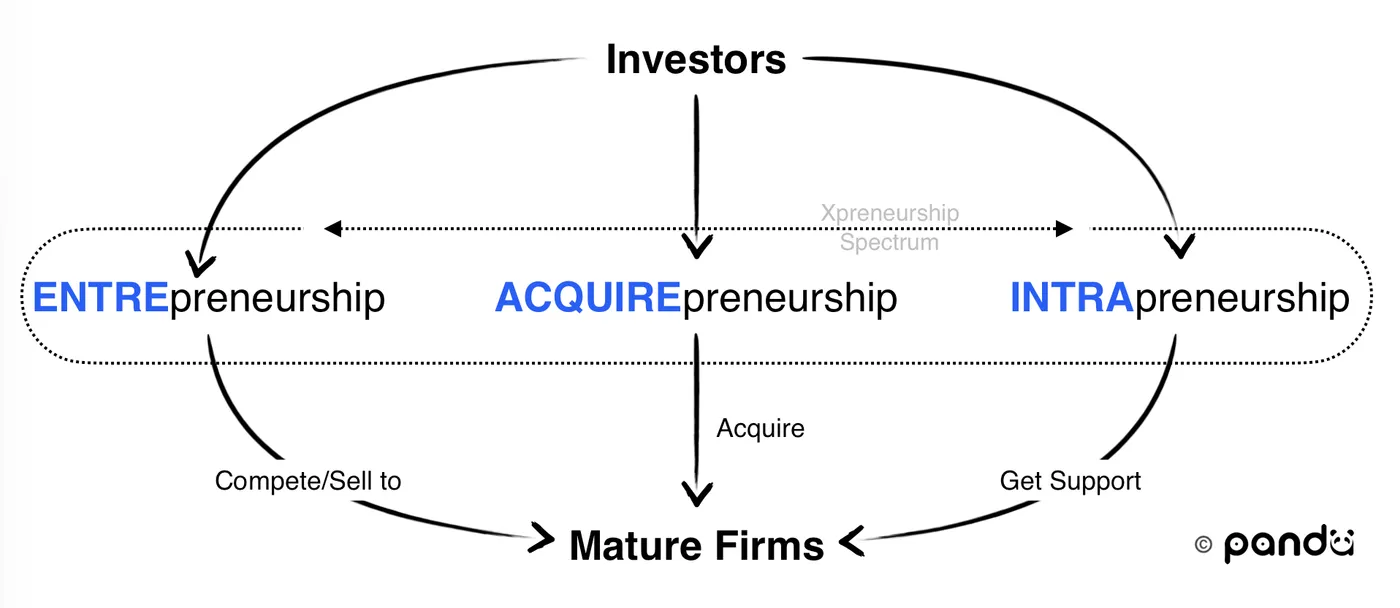
The Search Fund Path
On the search fund path, the entrepreneur finds and acquires a suitable company, then runs it.
Jim Southern founded Nova Capital in 1984 and was an early practitioner of the search fund model. After business school, Kirk Riedinger and Jamie Turner raised search capital and spent roughly two years looking for a company to buy; Stanford published their case in 1987. That same year, Jim Sharpe, who already had operating experience, found and acquired metal components manufacturer Extrusion Technology through a self-funded search.[1–3]
INSEAD describes three common approaches to financing a search: self-funded search, traditional search funds backed by multiple investors, and single-sponsor search backed by one principal investor.[4] Accelerators organize professional teams and resources that can support entrepreneurs using different financing models; holding companies provide a parent company through which businesses are owned. The 2026 international study by IESE and Stanford focuses on first-time traditional, or core, search funds. Its statistical coverage excludes self-funded search, single-sponsor search, accelerators, entrepreneurs in residence and hybrid arrangements.[5]
Traditional Search Funds: Separate Rounds for Search and Acquisition
A traditional search fund is usually launched by one or two entrepreneurs. They first raise search capital from a group of investors to cover their salary and the cost of finding and evaluating businesses. Once a target has been identified, they assemble equity and debt financing for the acquisition. IESE’s 2026 international study reports a median of 15 investors and median search capital of approximately $502,000 for traditional search funds launched in 2024–2025.[5]
Search-stage investors generally have the right, but not the obligation, to invest in the acquisition. Finding a company therefore still leaves the entrepreneur responsible for making the investment case, securing financing and organizing the transaction. After closing, the entrepreneur leads day-to-day operations, while investors participate in governance through the board and provide support through their experience and networks.
A solo entrepreneur typically has the opportunity to earn a management equity stake of approximately 20–25%; for a two-person team, the combined figure is typically around 30%. Earning that equity is tied to completing an acquisition, remaining with the business and meeting performance conditions. The entrepreneur earns ownership through search and operating contributions, while investors provide most of the capital.[6] For a fuller explanation of the two financing rounds, participants and equity arrangements, see Search Fund 101.
Self-Funded Search: The Entrepreneur Pays for the Search
Self-funded searchers use personal capital to find businesses and conduct early evaluations, typically without a salary during the search. Once they find an opportunity, they combine personal funds, loans, seller financing and outside equity to acquire the company and take over running the business. Funding the search personally does not mean paying the entire acquisition price out of pocket.
The entrepreneur can choose the geography, industry and target size, but also bears living expenses, evaluation costs and the cost of transactions that do not close. A 2017 Yale School of Management case illustrates potential ownership ranging from approximately 30% to 100%; the actual equity stake and operating control depend on financing and governance arrangements.[7]
The U.S. Small Business Administration’s 7(a) loan program and small-acquisition financing from the Japan Finance Corporation can support eligible business acquisitions.[8–9] Where a company’s cash flow can service the debt, borrowing can reduce the need for outside equity. However, the entrepreneur still needs to arrange financing and engage professional advisers.
Single-Sponsor Search: One Principal Capital Partner
In single-sponsor search, an institution, family office or principal investor funds the search and decides whether to finance the acquisition of a company the entrepreneur finds. The entrepreneur sources businesses, develops relationships with sellers and takes over operations. Loans and co-investors may also contribute to the acquisition financing.
Rather than raising search capital from multiple investors individually, the entrepreneur works primarily with one capital partner. The sponsor can organize diligence, transaction work and operating support. Both parties need to agree on the search focus, acquisition decisions and the entrepreneur’s operating authority. Ownership and decision rights are established through their agreement.
Halstatt Legacy Partners supported Jordan Scheiman’s 2017 acquisition of auto lender RedRock Financial. The sponsor supplied capital and professional support, Scheiman took over operations, and both parties approached the investment with a long-term holding horizon.[10]
Search Fund Accelerators and Support Platforms
A search fund accelerator typically supports a group of entrepreneurs at the same time. Its investment, diligence and transaction professionals help multiple searchers evaluate companies, arrange financing and complete acquisitions. It also provides training, search tools and mentoring. Entrepreneurs remain responsible for approaching owners, developing seller relationships and becoming CEO after the acquisition.[11]
Founded in 2015, Search Fund Accelerator (SFA) combines a cohort of entrepreneurs with committed capital.[12] Its equity incentive structure starts from a 25% allocation, with a small portion converted into an interest in a shared cohort fund. Entrepreneurs can therefore also participate in some of the equity value of other businesses acquired by members of their cohort.[13]
A platform may act as the principal investor or provide professional support to self-funded searchers. NextGen Growth Partners’ CEO-in-Residence Program,[14] SMEVentures in Asia-Pacific,[15] and Japan’s JaSFA/JSFP[16] also organize platform support, with different arrangements for capital, equity and the division of work.
Hybrid Arrangements: Self-Funded Search with Institutional Support
An entrepreneur may pay for the search while using an institution’s training and transaction services, or begin independently and obtain institutional funding after a period of working together. Search Fund Japan offers an initial search period of up to roughly six months, during which both parties can work together before deciding whether to fund a formal search. The institution then supports search expenses, diligence and the acquisition, while the entrepreneur also contributes personal capital.[17]
Pursuant Capital combines self-funded search with platform support. The entrepreneur pays search expenses, the platform provides training and transaction support, and the acquisition is financed with a combination of personal funds, loans and outside equity.
SPUR supports experienced operators in conducting a search and assembles investor capital for individual transactions. John Sheffield used this path to acquire school audiovisual equipment business Advanced Classroom Technologies in 2021, then became its CEO.[10]
Long-Term Capital and Holding Companies
A Long Duration Enterprise (LDE) secures long-term capital commitments before its first acquisition; a holding company owns businesses through a parent company. The former determines when capital is available and how long it can support the enterprise; the latter determines the ownership structure. The two can be combined.
Long Duration Enterprises: Capital Committed for Multiple Acquisitions
An LDE is designed from the outset for long-term operation and multiple acquisitions, with capital and governance arranged over a horizon of ten years or more. The entrepreneur first secures long-term capital commitments, then draws on them as needed for acquisitions and operations approved by the board. This reduces the need to organize a new round of financing each time a target is found.
This path developed out of the search fund ecosystem. The entrepreneur may initially run the first company, then gradually build an operating team and take responsibility for further acquisitions and capital allocation.
Stanford’s 2026 Search Fund Study reports LDEs separately from traditional search funds. Among its sample of 67 LDEs in the United States and Canada, median committed capital was $20 million. Of those that had completed a first acquisition, roughly two-thirds of founders initially ran that company themselves. Committed capital represents funding for the long-term platform, rather than the price of the first acquisition.[18] IESE identified another 13 LDEs outside the United States and Canada. Most were still at an early stage, with insufficient data to assess investment performance.[5]
Operator-Led Holding Companies: A Parent Company Owning and Supporting Multiple Businesses
An operator-led holding company owns businesses through a parent company. Acquisition funding may come from initial capital, outside equity, debt and operating cash flow. The entrepreneur may begin by running the first company, then make add-on acquisitions or build a portfolio of businesses. The parent allocates capital and participates in governance, while subsidiary leaders manage daily operations.
Newbury Franklin combines support for operators with a long-term holding company structure. The parent owns multiple businesses and supports entrepreneurs in finding, acquiring and becoming CEO of individual companies, with each operator responsible for their business. Co-founder Mark Anderegg describes this division of work in a Yale School of Management case; Newbury Franklin’s own materials also explain its operating approach.[10,19]
A holding company structure does not, by itself, establish a holding period or require long-term capital to have been raised before the first acquisition. It can be combined with an LDE, or expanded through transaction-by-transaction financing and operating cash flow. Related discussion appears in Long-Term Operating Paths for Search Fund Entrepreneurs.
Building a New Business Through Acquisition
Entrepreneurs can acquire companies or business units to obtain technology, teams, customers and distribution channels, then combine them into new products and services. Capital must cover not only the purchase price but also post-acquisition research and development, team integration and market development. Funding may come from the founders, institutional investors and debt, and the acquired businesses may be owned through a holding company.
When an existing company uses acquisitions to develop a new business, this is corporate ETA. The company can use its own funds, borrowing or equity financing, then combine the acquired capabilities with its existing activities. The group sets strategy and allocates capital; the new business team develops products and runs operations, with authority and incentives established by the group. A 2024 study of corporate venturing also identifies acquisition as a way to develop new businesses.[20]
A newly established platform can also start with acquisitions. Immersive technology and entertainment company COSM acquired Evans & Sutherland, including its subsidiary Spitz, and LiveLike’s VR business in 2020. Its capital backer was Mirasol Capital, part of the Winn family office. COSM combined display and 3D rendering technology, dome design and manufacturing, and sports content production. Drawing on technology used in planetariums and theme parks, it developed immersive venues for consumers. Its Los Angeles venue combines dome displays, live sports broadcasts and food and beverage service.[21–22]
SPACs: Acquisitions Through the Public Markets
A special purpose acquisition company (SPAC) first raises capital through an initial public offering (IPO), places the proceeds in a trust account and searches for a private company to take public through a merger. Common U.S. structures provide roughly two years to complete a transaction. If no deal is completed, the SPAC generally liquidates and returns the trust funds to public shareholders.
At the merger, public shareholders can generally choose to remain invested or redeem their shares. Redemptions reduce the cash available for the transaction. Sponsors may raise additional equity through a private investment in public equity (PIPE), or arrange other financing. The target’s existing shareholders may also exchange their equity for shares in the combined company. Final ownership depends on the transaction valuation, redemptions and financing.
The sponsor’s equity compensation is commonly called the promote. Under the traditional structure, sponsors acquire founder shares at a low cost, typically representing about 20% of the SPAC’s equity after the IPO but before the merger. Their post-merger percentage changes with the target valuation, redemptions and financing arrangements. In Klausner and colleagues’ study of 47 SPACs that completed mergers between January 2019 and June 2020, median net sponsor equity compensation represented 7.7% of post-merger equity.[23] Sponsors primarily organize financing, execute the transaction and participate in governance; the target’s management team usually continues to run the company. Jan Simon, Academic Director of IESE’s International Search Fund Center, includes this deal-sponsor path within a broad definition of ETA.[24–26]
Ownership, Returns and Trade-Offs
The path an entrepreneur chooses affects personal capital requirements, potential ownership, operating responsibility and decision-making authority. A larger equity stake may require more personal capital. Institutions that provide capital and a team also participate in investment and operating decisions. These differences shape potential returns, personal risk and operating autonomy.
Personal Capital and Equity Upside
Traditional search fund entrepreneurs primarily earn equity through their search and operating contributions. Self-funded searchers bear more of the upfront costs but may retain a larger ownership stake. The trade-off is how much personal capital and search risk the entrepreneur is willing to take on for a given share of the upside.
Capital from a sponsor or platform can reduce the personal funding burden. The entrepreneur participates in growth in the company’s value under the agreed equity and incentive arrangements.[10]
Operating Autonomy and Institutional Support
Self-funded searchers who retain control generally have more influence over the company’s direction and holding period. Traditional search fund entrepreneurs own a smaller stake but lead day-to-day operations as CEO. Major decisions, such as substantial investments, distributions or a sale, remain subject to board and shareholder arrangements. Equity ownership determines the share of economic returns; voting rights, board representation and delegated authority determine the scope of decision-making.
An independent search also means arranging financing and advisers independently. Sponsors and platforms can supply a transaction team, while participating in the search focus, acquisition decisions and budgets. In a Yale case, Judd Lorson joined SFA because he lacked transaction experience, accepting less search autonomy in return for support from investors, interns and professional advisers.[7] Institutional support can help fill experience gaps, but the entrepreneur still has to earn sellers’ trust, exercise judgment and learn from feedback. These responsibilities connect with the emphasis on learning, integrity and sustained action in the 7H searcher qualities discussed in Search Funds and Entrepreneurial Acquisitions.[24]
After taking over, the CEO has to organize the response to customer losses, employee departures and cash shortages, regardless of their equity stake. A platform can assist with analysis, but the CEO remains accountable for results. Managing several companies or building a new business adds responsibility for choosing operators, allocating capital and integrating technology and teams. See What Makes a Successful Acquisition Entrepreneur.
Comparing the Main Trade-Offs
| Path or arrangement | Equity and operating role | Main responsibilities | Professional support |
|---|---|---|---|
| Traditional search fund | A solo entrepreneur may earn a management equity stake of approximately 20–25% over time. | Find a business, arrange financing, lead operations and work with investors. | Investor experience and introductions, board guidance and professional advisers. |
| Self-funded search | The Yale case illustrates potential ownership of approximately 30–100%, including the possibility of control. | Fund the search and organize capital, advisers and operations. | A network of mentors, investors and advisers built by the entrepreneur. |
| Single-sponsor search | Hold equity alongside the principal institution and become CEO. | Find companies, make the acquisition case and take over operations. | Sponsor capital and support for transaction execution and operations. |
| Search fund accelerators and support platforms | SFA’s structure starts from a 25% allocation; other platforms use their own arrangements. | Source opportunities, develop seller relationships and lead operations. | Shared tools, transaction professionals, mentors and peers. |
| LDE | The founder may first serve as CEO of the initial business, then manage a portfolio. | Organize long-term capital, build management teams and make further acquisitions. | Long-term investors and a board, with a team built over time. |
| Operator-led holding company | Own equity in the parent and organize the operation of multiple businesses. | Select subsidiary operators, allocate capital and support each business. | Subsidiary operators and the parent company’s team. |
| Building a new business through acquisition | Equity reflects capital contributions and governance arrangements; the entrepreneur organizes the new business. | Integrate technology and teams, develop products and enter new markets. | Specialist teams in acquired businesses, capital providers and outside advisers. |
| SPAC | Receive sponsor equity and participate in governance. | Find a target and organize financing and the merger. | Investment banks, professional advisers and the target’s management team. |
Related Acquisition and Investment Concepts
MBI and MBO: Where the Incoming Management Comes From
A management buy-in (MBI) occurs when an external manager or management team acquires equity and replaces the existing management.[27] A management buy-out (MBO) occurs when the company’s existing directors or senior managers purchase all or part of its equity.[28]
When an outside entrepreneur finds a company through a search, acquires it and becomes CEO, the transaction can also have the characteristics of an MBI. MBI and MBO describe where the incoming management team comes from. They do not establish how the search is funded, the acquisition is financed or equity incentives are structured.
Private Equity and Strategic Acquisitions: Capital Providers and Acquisition Objectives
Private equity firms organize capital to invest in privately held companies and participate in governance. They can lead acquisitions themselves or sponsor entrepreneurs in finding and operating businesses.
A strategic acquisition is initiated by an existing company to achieve synergies with its existing business, enter a market or add capabilities, with the target generally becoming part of the group. These terms describe the capital provider’s or buyer’s investment objectives and can be combined with different ways of taking over management.
Brownfield and Greenfield Investment: Existing Businesses or New Development
Brownfield investment involves companies, facilities or assets that have already been built or put into operation, in contrast to greenfield investment, which starts from scratch. ETA further involves acquiring ownership and taking operating responsibility.[29]
Search Funds and Entrepreneurial Acquisitions also discusses searches that lead to greenfield entrepreneurship. An entrepreneur may conclude that starting a new business is more attractive than buying an existing one, and work with investors to establish a company instead.[24] This is another entrepreneurial path that can emerge from a search. Acquisition and new development can also be combined: COSM acquired technology and production capabilities, then built new immersive venues. The acquisitions brought existing businesses into the company; the venue development created new operating facilities.[30]
Practical Considerations in China and Asia-Pacific
Putting these paths into practice in China and Asia-Pacific depends on local financing and business handover arrangements. Which investors are willing to fund a search before a specific acquisition target has been identified, and what rights do they expect in return? Once a company has been found, the availability and terms of loans, outside equity and seller installment payments affect the entrepreneur’s personal investment and retained ownership.
The operating handover depends on the division of responsibilities between the seller and the incoming entrepreneur. If the seller retains equity or stays with the business, how are customer relationships and key decisions transferred? With institutional sponsorship or platform support, the parties also need to establish who decides on acquisitions, budgets, management appointments and a future sale.
Sources
- [1]University of Chicago Booth School of Business. The Evolution of Entrepreneurship through Acquisition. 2016.
- [2]Harold Grousbeck and David Dodson. Kirk Riedinger and Jamie Turner. Stanford Graduate School of Business, 1987. Case SB102.
- [3]Harvard Business School Baker Library. James Sharpe. Oral history interview, January 2003.
- [4]Ivana Naumovska and Kudirat Olateju. Buy then Build: Be an Entrepreneur Without the Start-Up. INSEAD Knowledge, January 20, 2025.
- [5]Ann-Sophie Kowalewski, Juan Naranjo, Peter Kelly and Jan Simon. International Search Funds – 2026: Selected Observations. IESE Business School and Stanford Graduate School of Business, 2026. Data through the end of 2025.
- [6]Stanford Graduate School of Business. A Primer on Search Funds: A Practical Guide for Entrepreneurs Embarking on a Search Fund. 2026 edition.
- [7]A. J. Wasserstein. Searching for a Search Fund Structure: A Student Takes a Tour of Various Options. Yale School of Management, 2017. Relevant material: the Judd Lorson case and Exhibit 1, p. 10.
- [8]U.S. Small Business Administration. 7(a) Loans.
- [9]Japan Finance Corporation. スモールM&A向け融資の活用法 (small-acquisition financing).
- [10]Nicholas Rice and A. J. Wasserstein. Exploring Various Search Fund Structures. Yale School of Management, 2021. Relevant sections: self-funded search, accelerators, single sponsorship, self-funded search accelerators, mid-career accelerators and holding companies.
- [11]Search Fund Accelerator. How It Works.
- [12]Search Fund Accelerator. Who We Are.
- [13]Search Fund Accelerator. SFA Economics.
- [14]NextGen Growth Partners. CEO-in-Residence Program.
- [15]SMEVentures. About SMEVentures.
- [16]Japan Search Fund Accelerator. Japan Search Fund Platform.
- [17]Search Fund Japan. 面向希望成为收购创业者的人 (information for prospective acquisition entrepreneurs).
- [18]Peter Kelly, Stefanos Zenios and Dom Ng. 2026 Search Fund Study: Selected Observations. Stanford Graduate School of Business, 2026.
- [19]Newbury Franklin. Buyers and Long-Term Builders of Recurring Revenue Businesses.
- [20]Nils Dall, Orestis Terzidis and Leon Krooß. Harmonizing Corporate Venturing Dimensions and Its Characteristics: A Systematic Analysis. Management Review Quarterly, published online June 26, 2024.
- [21]COSM. Cosm Powers Immersive Experiences Around the World. PR Newswire, January 26, 2021.
- [22]COSM. Cosm Is Here: First Experiential Venue to Open in Los Angeles’ Hollywood Park on June 29. PR Newswire, April 17, 2024.
- [23]Michael Klausner, Michael Ohlrogge and Emily Ruan. A Sober Look at SPACs. 2020 working-paper version; sample of 47 SPAC mergers completed between January 2019 and June 2020. Net sponsor equity compensation: pp. 20–21 and Table 2.
- [24]Jan Simon; translated by 王逸樵. 搜索基金与收购式创业:如何收购企业并走向成功. Chinese edition of Search Funds and Entrepreneurial Acquisitions. Shanghai University of Finance and Economics Press, 2025. ISBN 978-7-5642-4538-2. Relevant chapters: Chapter 1 on ETA paths and greenfield opportunities; Chapter 2 on searcher qualities; Chapter 10 on boards and governance.
- [25]U.S. Securities and Exchange Commission, Office of Investor Education and Advocacy. What You Need to Know About SPACs — Updated Investor Bulletin. August 21, 2024.
- [26]U.S. Securities and Exchange Commission. Special Purpose Acquisition Companies, Shell Companies, and Projections. 2024. Release No. 33-11265. Structure overview: pp. 8–11.
- [27]Deutsche Börse. MBI (Management Buy-in).
- [28]HM Revenue & Customs. Management Buy Out. Updated 2025.
- [29]World Bank Group. Shifting Shores: Foreign Direct Investment Relocations and Political Risk. 2025.
- [30]COSM. Cosm and Award-Winning Artist Nancy Baker Cahill to Unveil First-Ever Shared Reality Art Experience. Includes the groundbreaking announcement for the first venue at Hollywood Park in Los Angeles.